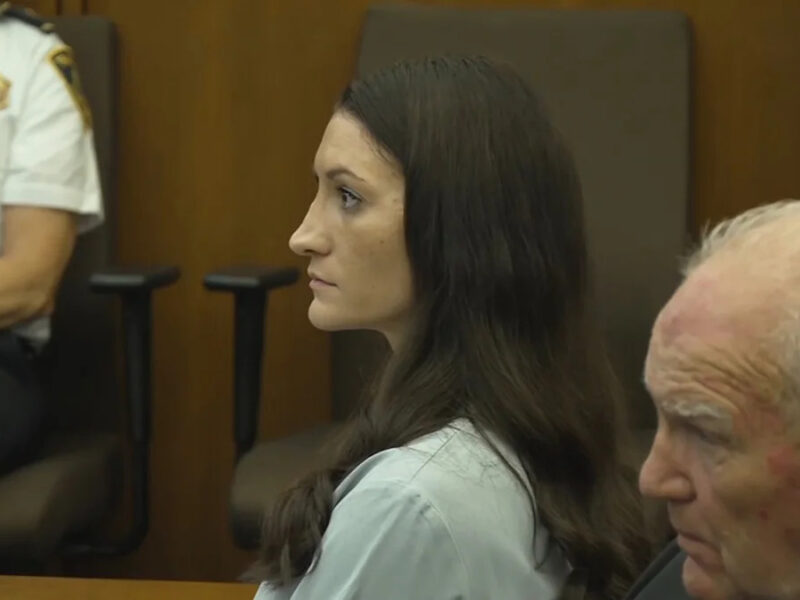
FEEL LIKE GOING TO DIE: Nurse Reveals Lindsay Clancy’s Messages and Concerns About Her Mental Health
FEEL LIKE GOING TO DIE: Nurse Reveals Lindsay Clancy’s Messages and Concerns About Her Mental Health
Nurse Rebecca Jollotta testified that Lindsay Clancy had repeatedly requested changes to her psychiatric medication, even though she was aware that adjusting treatment could potentially impact her mental stability. Her testimony has now brought renewed attention to the messages Clancy sent during a very difficult and emotionally unstable period leading up to the tragic deaths of her three children.
The case continues to raise serious questions about mental health care, medication management, and the warning signs that may have been present in the days and weeks before the incident.

PLYMOUTH, Mᴀss. — In a quiet courtroom in Plymouth Superior Court on Tuesday, Aug. 11, 2026, psychiatric nurse pracтιтioner Rebecca Jollotta took the stand and read aloud a series of messages that painted a portrait of profound despair. The messages came from Lindsay Clancy, the former labor and delivery nurse accused of strangling her three young children in their Duxbury home on Jan. 24, 2023.
“I also just feel concerningly numb right now, like I have no emotion whatsoever. I feel like I’m going to die, and I don’t care. What do I do about this?” Clancy wrote in one patient portal message in early December 2022, according to Jollotta’s testimony and prosecutors’ accounts.
The testimony, delivered on Day 11 of Clancy’s murder trial, offered jurors an intimate window into the weeks leading up to the tragedy. It revealed a mother cycling through medications, reporting intrusive thoughts, battling severe insomnia, and repeatedly seeking changes to her treatment regimen even as she expressed fear that switching drugs could further destabilize her mental health.
Clancy, now 35 (she marked her 36th birthday in court during the proceedings), has pleaded not guilty to three counts of first-degree murder in the deaths of her daughter Cora, 5; son Dawson, 3; and infant son Callan, who was 8 months old at the time and died three days after the attack. She does not dispute that she caused their deaths by strangling them with exercise bands while her then-husband, Patrick Clancy, was out of the house on errands she had asked him to run. Afterward, she cut her wrists and neck and jumped from a second-story window in an apparent suicide attempt that left her paralyzed from the waist down.
Her defense attorney, Kevin Reddington, is pursuing a lack-of-criminal-responsibility defense under Mᴀssachusetts law—essentially an insanity defense—arguing that Clancy was suffering from severe postpartum mental illness, possibly postpartum psychosis, exacerbated by a complex and rapidly changing array of psychiatric medications. Prosecutors, led by the Plymouth County District Attorney’s Office, contend that the killings were deliberate and premeditated, and that while Clancy clearly struggled with depression, anxiety, and insomnia, she did not meet the legal threshold of lacking criminal responsibility.
The Messages Begin: Late November 2022
Jollotta, who works in South Shore Health’s Perinatal Behavioral Health Program, first connected with Clancy virtually on Nov. 29, 2022. Clancy had been struggling with postpartum issues following the birth of Callan in May 2022. She had previously been under the care of another provider, Julie Paul, who was leaving the clinic.
From the start, sleep was the dominant crisis. Clancy reported severe insomnia and anxiety. She was on day four of the antidepressant mirtazapine (Remeron) when the messaging intensified. On Nov. 30, she asked Jollotta whether it would be safe to stop the medication after only five days, saying her depression felt “much much worse” and that she had slept only about two hours.
Jollotta responded by emphasizing that antidepressants typically require four to six weeks to reach full clinical benefit. She prescribed Valium for anxiety and Seroquel (quetiapine), an antipsycH๏τic also used for mood stabilization and insomnia. She reᴀssured Clancy that intrusive thoughts are common in postpartum depression and anxiety and do not reflect on a person’s character as a mother. She sent resources, including mood charts for tracking sleep, anxiety, and irritability, and recommended a book тιтled Good Moms Have Scary Thoughts.
Clancy’s replies revealed both desperation and self-awareness. “I really don’t like the way I feel on the Remeron and I know that I can’t stick with taking it,” she wrote on Dec. 1. “I started having very intrusive thoughts that I never had before.” She apologized for the volume of messages: “I’m sorry for all of the messages, it’s just a very scary, stressful time for me, and starting new meds with side effects is very scary to me.”
Jollotta testified that Clancy repeatedly tried to alter or discontinue medications despite understanding the risks. “I believe I responded to that, reᴀssuring her that it’s understandable to have fears, concerns about starting medications, and I sent her a detailed description of common questions and answers I get from patients about medications,” Jollotta told the jury.
Escalating Distress and the ‘Going to Die’ Message
The messages continued in a rapid flurry. On Dec. 2, Clancy reported waking at midnight with “horribly intrusive thoughts, wanting it to all be over.” She took Ativan (lorazepam), a benzodiazepine, and the thoughts subsided. She expressed growing fear that she was becoming dependent on the drug after roughly two and a half weeks of daily use following a bad reaction to Zoloft.
“I also just feel concerningly numb right now, like I have no emotion whatsoever. I feel like I’m going to die and I don’t care. What do I do about this?” she wrote. Jollotta testified that she did not interpret the statement as active suicidal ideation. Instead, she viewed it as consistent with depression and anhedonia—the inability to feel pleasure. She provided information about 24-hour psychiatric crisis services and urged Clancy to continue the prescribed course while trying non-pharmacological sleep strategies.
Clancy also wrote that she felt she was “not being heard” and that providers were “throwing all these meds at my insomnia.” She reported periods of getting almost no sleep yet not feeling tired—a detail that later prompted Jollotta to consider the possibility of undiagnosed bipolar disorder or a mixed state.
In-Person Concerns and the Bipolar Question
On Dec. 6, Clancy and her husband Patrick attended an in-person appointment. Jollotta noted that Clancy’s mood was anxious but her thoughts were linear and goal-directed. She reported no hallucinations, voices, or active suicidal or homicidal ideation at that visit. Scores on the Edinburgh Postnatal Depression Scale had risen from a moderate 17 out of 30 on Nov. 29 to 21 out of 30, indicating moderate to severe depression.
Jollotta raised the possibility of bipolar disorder, citing the adverse reaction to Zoloft (an SSRI), extreme sleep disruption without corresponding fatigue, and the overall presentation. Patrick Clancy, according to testimony, stated he did not believe his wife was bipolar. The plan shifted toward tapering benzodiazepines while carefully managing other medications.
Over the following days, Clancy continued messaging about poor sleep despite Valium and melatonin, sometimes adding Benadryl in desperation. She asked whether she could combine medications safely and repeatedly sought adjustments. Jollotta continued to counsel patience and consistency, while also discussing higher levels of care.
By mid-December, Clancy reported persistent suicidal and intrusive thoughts. She explored inpatient options. She was not admitted to one program and later reported that Women & Infants Hospital in Rhode Island also declined admission; a doctor there reportedly suggested stopping Seroquel. Jollotta learned of these developments largely through Clancy’s own portal messages.
Cross-Examination and Broader Context
On cross-examination, Reddington pressed Jollotta on communication gaps. She acknowledged she never spoke with Dr. Jennifer Tufts, the psychiatrist who saw Clancy approximately 14 times between late September 2022 and January 2023, while Jollotta herself saw Clancy only a handful of times. Reddington suggested that Clancy had been left without adequate support during periods when Jollotta was unavailable, including a vacation, and that Clancy had been rejected from a postpartum program amid concerns about overmedication.
Jollotta maintained that she encouraged consistency with medication, provided crisis resources, and pushed for more intensive treatment when symptoms warranted it. She testified that she observed no clear signs of psychosis or mania during her contacts with Clancy, though she remained alert to the possibility of bipolar spectrum issues.
The testimony fits into a larger pattern that has emerged in the trial. Earlier evidence included journal entries in which Clancy wrote of feeling she was “drowning every day,” of overwhelming guilt over sleep-training her infant, of brain fog, and of a desperate desire for a mental break. Patrick Clancy has testified that his wife’s condition deteriorated after the birth of Callan, that she cycled through multiple providers and medications, and that she disclosed intrusive thoughts of harming the children as well as suicidal ideation, though he said she never described a concrete plan.
Clancy had sought help repeatedly—emergency rooms, crisis lines, specialized perinatal programs, and a voluntary admission to McLean Hospital in early January 2023, from which she was discharged about 19 days before the killings. Defense experts are expected to argue that the combination of underlying vulnerability, sleep deprivation, hormonal shifts after childbirth, and a rapid succession of medications (defense counsel has referenced roughly a dozen different psychiatric drugs over several months) precipitated a psycH๏τic break. Prosecutors point to evidence of planning—sending Patrick out of the house with specific errands timed to create a window of opportunity—and argue that Clancy’s communications and behavior demonstrated sufficient awareness and intentionality.
A Case That Resonates Beyond the Courtroom
The Clancy case has drawn national attention precisely because it sits at the intersection of maternal mental health, the limitations of the current treatment system, and the legal standards for criminal responsibility. Postpartum psychosis is rare but recognized as a medical emergency that can involve hallucinations, delusions, and rapid shifts in mood and reality-testing. Intrusive thoughts of harm, by contrast, are more common in postpartum depression and anxiety and do not necessarily indicate psychosis or intent to act. Distinguishing among these presentations in real time, especially across multiple providers who may not fully share records, remains a significant clinical challenge.
Jollotta is among the medical professionals named in a civil lawsuit filed by Clancy and her ex-husband alleging failures in communication, diagnosis, and medication management. She has denied the allegations.
As the trial continues, jurors will hear from additional medical experts, review further records, and ultimately decide whether Clancy’s mental state at the time of the killings met the high legal bar for lack of criminal responsibility. If convicted of first-degree murder, she faces life without parole. If found not responsible, she would be committed to a psychiatric facility for treatment and ongoing evaluation.
The messages read in court this week do not resolve that question. They do, however, document in Clancy’s own words a period of intense suffering, fear of medication side effects and dependence, and a persistent search for relief that, by her account and that of her providers, remained elusive in the final weeks of 2022. “This is going to get better,” Jollotta had written in response to one of the most alarming messages. Whether the system surrounding Clancy was equipped to make that promise true is a question the jury, and the broader public conversation about maternal mental health, continues to confront.