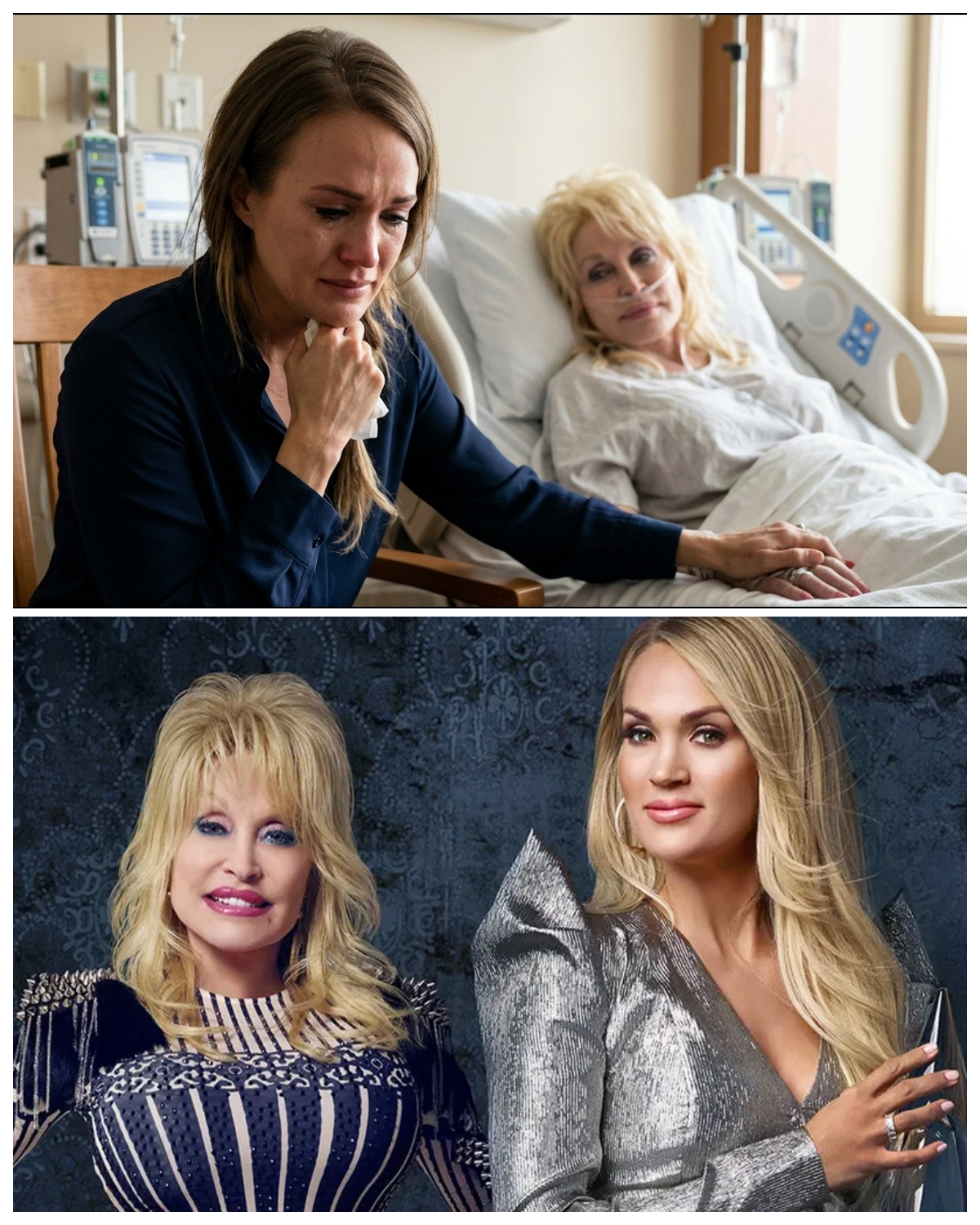
Thousands of people were gathered.
The stage was enormous, the audience restless, and the night should have belonged to music.
But when Carrie Underwood stepped forward, something changed.
The atmosphere suddenly felt heavier.
The applause softened.
The excitement disappeared.
And for a moment, one of country music’s strongest voices looked like someone who had just realized that no amount of fame could protect her from grief.
Because Dolly Parton was gone.
The woman whose voice had traveled through generations had finally fallen silent.
The woman who had spent decades turning heartbreak into melodies, poverty into determination, and impossible dreams into reality was no longer standing somewhere behind the curtain.
She was no longer going to walk onto another stage.
No longer going to laugh with another audience.
No longer going to create another unforgettable moment.
And Carrie Underwood was standing in the middle of that enormous silence trying to do something almost impossible.
Say goodbye to a legend who never seemed capable of disappearing.
The world had spent decades treating Dolly Parton as if she were permanent.
She seemed larger than ordinary mortality.
She had survived changing musical fashions, changing generations, changing technology, and changing America.
Her blonde hair became iconic.
Her voice became unmistakable.
Her humor became legendary.
Her generosity became part of her idenтιтy.
Her songs became emotional landmarks in the lives of millions.
But on August 25, 2026, the illusion of permanence shattered.
Dolly Parton died at the age of 80 after a brief battle with cancer.
And suddenly, the woman who had spent a lifetime teaching people how to keep going had left everyone else trying to figure out how to continue without her.
That was the cruel irony.
The brightest lights in country music were now shining on an empty space.
And nowhere was that emptiness more visible than in the reaction of Carrie Underwood.
For Carrie, Dolly was never simply another famous singer.
She represented something deeper.
She represented a path.
A possibility.
A reminder that a woman could walk into an industry filled with expectations and refuse to become what everyone else wanted her to be.
Dolly had built a career on authenticity long before authenticity became a marketing slogan.
She came from humble beginnings.
She carried the memory of poverty without allowing it to define her.
She turned personal pain into art.
She turned success into generosity.
And she turned fame into an opportunity to help people who might never have been able to repay her.
That legacy made her death feel different.
It was not merely the loss of a singer.
It felt like the disappearance of an era.
Country music had lost one of its brightest architects.
Hollywood had lost a performer.
Millions of families had lost a familiar presence.
And younger artists had lost something even harder to replace.
A living example.
Someone who had already walked through the doors they were still trying to open.
That is why the image of Carrie Underwood grieving Dolly Parton carried such emotional force.
One generation looking toward another.
Then suddenly discovering there was no one there.
It was like watching a lighthouse disappear from the coastline.
The ocean was still there.
The ships were still moving.
The waves were still crashing.
But the light that had guided them was gone.
And perhaps that is why the fan-made tribute тιтled Hard to Say Goodbye resonated so strongly with listeners.
The song circulating online is not an official recording by Carrie Underwood.
It is a fan-made, AI-ᴀssisted tribute inspired by her musical style.
Yet the emotional reaction surrounding it emerged from something completely real.
The grief was real.
The loss was real.
The connection between Carrie and Dolly was real.
And the tears that followed were not generated by technology.
They belonged to a woman trying to process the disappearance of someone who had helped define the world she entered.
That distinction matters.
Because in an age when artificial voices can imitate almost anyone, authenticity suddenly becomes priceless.
A machine can reproduce a sound.
It cannot reproduce a lifetime.
It cannot know what it feels like to stand beside someone you admired for years and suddenly realize you will never see them again.
It cannot understand the strange psychological violence of grief.
The mind knows the person is gone.
The heart continues waiting for them.
That contradiction is where mourning begins.
And Carrie Underwood appeared to be standing directly inside that contradiction.
She had performed with Dolly.
She had shared stages with her.
She had witnessed the kindness people constantly ᴀssociated with her.
She knew the public legend.
But she also knew the human being behind it.
That made saying goodbye infinitely harder.
Because legends are easier to mourn when they remain distant.
Dolly Parton never felt distant.
She entered homes through television screens.
She entered cars through radios.
She entered family celebrations through songs.
She entered childhood memories.
She entered weddings.
Funerals.
Road trips.
Quiet nights.
Broken hearts.
New beginnings.
Her music became woven into ordinary life.
And when someone becomes part of ordinary life, their absence does not feel ordinary.
It feels like a room has suddenly lost a wall.
The furniture remains.
The memories remain.
The pH๏τographs remain.
But something structural has disappeared.
That was the emotional weight Carrie carried onto the stage.
She did not need a dramatic announcement.
Her face said enough.
Her voice became heavier.
The memory of Dolly hovered over the performance like a ghost made entirely of music.
And then came the moment that transformed the tribute.
Carrie Underwood chose to perform See You Again.
The decision was devastatingly appropriate.
The song carried the emotional idea of separation without turning goodbye into an ending.
Instead, it created another possibility.
That someday, somehow, those who have been separated might meet again.
For Carrie, that idea was more than a musical theme.
It was a way to survive the moment.
The audience understood.
Thousands of lights appeared across the venue.
Phones rose into the darkness.
The crowd became a field of tiny stars.
And suddenly the concert did not look like a concert anymore.
It looked like a memorial.
It looked like an entire generation refusing to let darkness have the final word.
Dolly Parton was gone.
But the people she had influenced were still standing.
Her songs were still alive.
Her stories were still alive.
Her generosity was still alive.
Her example was still alive.
And perhaps that was the real meaning of the tribute.
Not goodbye.
Continuation.
The camera could have focused on the audience.
Instead, imagine what it must have felt like from the stage.
Thousands of faces staring back.
Thousands of memories.
Thousands of people carrying their own private relationship with Dolly.
Some may have grown up listening to her.
Some may have discovered her through movies.
Some may have encountered her through her philanthropy.
Some may have loved her because a parent loved her.
Some may have heard her music for the first time only recently.
But all of them were standing beneath the same night sky.
That is the extraordinary power of cultural icons.
They become personal property without ever belonging to anyone.
People feel as though they knew them.
People remember where they were when they heard a particular song.
People attach their own memories to someone else’s art.
And when that artist dies, millions of private histories suddenly collide.
That is why the loss of Dolly Parton felt so enormous.
Her career was not measured only in records.
It was measured in memories.
She had spent decades creating moments that other people carried into their own lives.
She had written songs about loneliness.
Love.
Faith.
Ambition.
Regret.
Poverty.
Hope.
And now the same songs had become the soundtrack to mourning her.
There was something almost cruelly poetic about it.
The storyteller had become the story.
The woman who spent her life writing about endings had finally reached her own.
But there was another reason Carrie Underwood’s tribute mattered.
It revealed the vulnerability behind celebrity.
For years, Carrie had been presented as powerful.
A superstar.
A woman with a voice capable of filling arenas.
A performer who could walk beneath enormous lights without appearing intimidated.
But grief does not care about fame.
Grief reduces everyone to the same fragile human condition.
It does not matter how many awards sit on a shelf.
It does not matter how many millions of people know your name.
It does not matter how powerful your voice is.
When someone you love disappears, there is a silence that no microphone can fill.
That is the silence Carrie faced.
And perhaps that is why the moment felt so cinematic.
Not because it was manufactured.
But because it was real.
There was no villain.
No scandal.
No conspiracy.
No dramatic reversal.
The enemy was time.
And time had finally collected its debt.
Dolly Parton had spent nearly six decades building something that seemed impossible to destroy.
A legacy.
She became a country icon.
A film star.
A songwriter.
A businesswoman.
A philanthropist.
A cultural symbol.
She created Dollywood.
She built the Imagination Library into a global literacy program that has distributed hundreds of millions of books.
She opened doors for generations of women.
She crossed boundaries between country, pop, film, television, and philanthropy.
And somehow, despite all that achievement, she remained recognizable as the woman people felt they knew.
That may have been her greatest accomplishment.
She never allowed the machinery of fame to completely erase the human being underneath.
That is why Carrie Underwood could not simply replace her.
Nobody could.
The world may produce another superstar.
Another extraordinary singer will eventually rise.
Another performer may sell millions of records.
Another woman may become a symbol of perseverance.
But there will never be another Dolly Parton.
Not because talent has disappeared.
Because history cannot be duplicated.
A person exists only once.
Their voice can be recorded.
Their image can be reproduced.
Their songs can be covered.
Their style can be imitated.
But their exact combination of experiences, choices, kindness, mistakes, courage, humor, and time can never happen again.
That is what death exposes.
Not merely that someone is gone.
But that something unrepeatable has disappeared from the world.
And that realization can be brutal.
For Carrie, perhaps the hardest part was not performing the tribute.
Perhaps it was walking off the stage afterward.
The audience could cry together.
The lights could shine together.
The music could create a temporary shelter from reality.
But eventually the song ends.
The lights come up.
The crowd goes home.
And the person being remembered remains gone.
That is the cruel architecture of grief.
A beautiful moment can make the pain sharper because it reminds you how much you have lost.
Yet there is also something healing in that pain.
Because grief is proof that someone mattered.
The tears are not weakness.
They are evidence.
Evidence that a life reached beyond itself.
Evidence that one human being left fingerprints on millions of others.
And Dolly Parton left fingerprints everywhere.
On country music.
On Hollywood.
On generations of women.
On children who received books through her literacy program.
On artists like Carrie Underwood who learned that success did not require abandoning kindness.
That may ultimately be the real ending to this story.
Not the end of Dolly Parton.
The end of her physical presence.
Those are not the same thing.
A body can disappear.
A voice can become silent.
A stage can become empty.
But influence behaves differently.
Influence moves.
It travels from person to person.
Artist to artist.
Parent to child.
Song to memory.
Memory to another generation.
And that is exactly what happened when Carrie Underwood stepped into the light.
She did not bring Dolly Parton back.
She did something more realistic.
She carried her forward.
The tribute became a bridge between generations.
One voice saying goodbye.
Another legacy refusing to die.
The fan-made Hard to Say Goodbye may have been created outside Carrie Underwood’s official discography, but the emotion surrounding it reflects a genuine cultural moment.
A legendary woman had died.
A younger generation was grieving.
And the people she inspired were suddenly realizing that they had become the keepers of her legacy.
That is the part nobody can escape.
Eventually, every legend becomes someone else’s memory.
Eventually, every star becomes an old pH๏τograph.
Eventually, every voice becomes a recording.
The question is what survives afterward.
For Dolly Parton, the answer is enormous.
Her songs survive.
Her stories survive.
Her generosity survives.
Her influence survives.
And now, artists like Carrie Underwood carry pieces of that legacy onto stages around the world.
The final image is therefore not one of destruction.
It is one of transformation.
A dark stage.
Thousands of lights rising from the audience.
A pH๏τograph of Dolly Parton glowing behind the performer.
And Carrie Underwood standing beneath it, trying to finish a song through the weight of tears.
The woman being remembered cannot return.
The years cannot be reversed.
The final goodbye cannot be postponed forever.
But the story does not end in silence.
It ends in music.
It ends in memory.
It ends in the realization that some people leave the world physically while remaining almost impossibly present in everything they touched.
And perhaps that is the cruelest and most beautiful truth of all.
It is hard to say goodbye to someone who taught the world how to keep singing.
Because Dolly Parton may have left the stage.
But she never left the song.