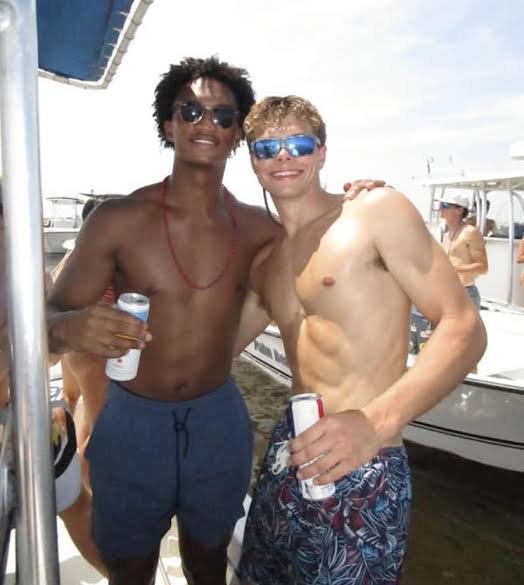

This one concerns compartments visible near the bow of one of the boats connected to the broader timeline being examined online.
ScreensH๏τs and video stills have circulated among people following the case, with commenters repeatedly asking what those compartments were designed to hold.
Storage?
Safety equipment?
Fishing gear?
Personal belongings?
Or something else entirely?
The existence of compartments on a boat is obviously not suspicious by itself. Storage spaces are common on recreational vessels.
But that has not stopped people from asking a more important question:
Were they ever examined during the investigation?
That distinction matters.
The question is not whether a compartment exists.
The question is whether investigators documented what was inside it, whether pH๏τographs were taken, whether contents were inventoried and whether anything relevant to Nolan’s disappearance or death was recovered.
Without official documentation answering those questions, speculation continues to fill the vacuum.
TWO SEPARATE ISSUES — ONE GROWING TRUST PROBLEM
The business-promotion debate and the boat-compartment discussion are not necessarily connected.
There is no evidence presented here that they are.
But both controversies reveal the same underlying problem surrounding the Nolan Wells case:
A growing portion of the public no longer feels that it has a complete picture.
Every unanswered question creates another theory.
Every conflicting interview creates another round of scrutiny.
Every unusual detail becomes another screensH๏τ shared thousands of times.
And when people believe important information remains missing, even seemingly ordinary details begin attracting intense attention.
That is exactly what is happening now.
The branding may ultimately mean nothing.
The compartments may contain nothing relevant.
The interviews may be entirely legitimate.
But until clearer answers emerge, people following the case are unlikely to stop asking.
THE QUESTIONS NOW PILING UP
Who organized the recent podcast interviews?
Were any participants paid?
Were business promotions intentionally placed alongside discussions of Nolan’s case?
Did those businesses financially benefit from increased attention?
And separately:
Were the bow compartments on the boat searched?
What were they designed to contain?
Was their contents documented?
Were investigators satisfied that nothing inside had evidentiary value?
None of these questions, by themselves, establish wrongdoing.
But together, they illustrate why the Nolan Wells case continues to generate such intense public scrutiny.
Because months into the controversy, the biggest problem may no longer be a shortage of theories.
It may be a shortage of answers strong enough to silence them.
And until those answers arrive, every interview, every image and every unexplained detail will continue to be examined frame by frame.
Because for people demanding clarity about what happened to Nolan Wells, nothing now feels too small to question.