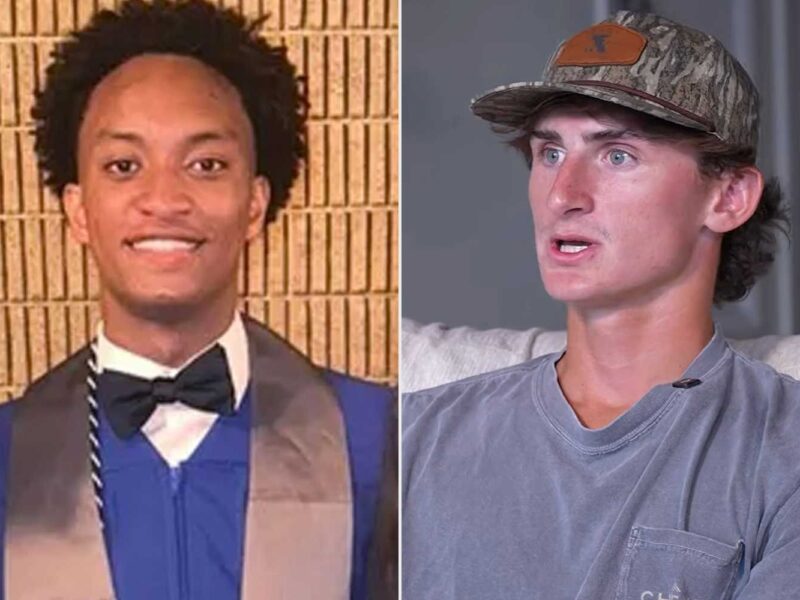
“THAT WAS MY BROTHER”: Nolan Wells’ Friend Breaks Silence As The Group Pushes Back Against Online Claims
“THAT WAS MY BROTHER”: Nolan Wells’ Friend Breaks Silence As The Group Pushes Back Against Online Claims
A powerful statement from one of Nolan Wells’ closest friends is drawing attention as he describes the pain of losing someone he considered family while watching public speculation grow around the people who were closest to Nolan.
He says they picked Nolan up nearly every day, spent years together, and built a friendship that went far beyond a casual connection. Now, while grieving their friend, the group says they are also facing accusations and narratives they believe do not reflect the relationship they shared with Nolan.
The biggest question many are now asking: how well did the public really know the bond between Nolan and the friends who were with him that day?
In the months since the death of 18-year-old Nolan Xavier Wells, a parallel story has unfolded alongside the official investigation. While authorities continue their work to determine how Wells died after disappearing during a July 4 gathering on Horn Island, the young men who were with him that day have faced a sustained wave of public accusation, speculation, and personal attack. In a series of recent interviews, several of those friends have spoken at length in an effort to counter what they describe as false narratives and damaging claims that have taken root online. Central to their message is a simple and repeated ᴀssertion: Nolan Wells was not a distant acquaintance or a convenient prop in someone else’s story. He was, in their words, a brother.
Warren Hudson, Jax Pitalo, and Morgan Seymour have emerged as the most visible voices among the group. In conversations recorded for The Officer Tatum Show and referenced across multiple news outlets, they have described years of shared history with Wells that began in school and continued into early adulthood. Hudson has been particularly direct, stating that Wells was not merely a friend but someone he regarded as family. The young men have recounted ordinary patterns of teenage and early college life—picking Wells up nearly every day, spending time in one another’s homes, maintaining relationships that extended to parents and siblings. These details, they argue, stand in contrast to online suggestions that their connection to Wells was superficial or opportunistic.
The interviews arrive against a backdrop of intense and often hostile public attention. Wells disappeared on July 4, 2026, during a large Independence Day gathering on Horn Island, a barrier island roughly ten miles off the Mississippi Gulf Coast. He had traveled there by boat with a group of friends. When the group returned to the mainland later that afternoon, Wells was not among them. His cellphone and keys remained on the boat. His mother reported him missing late that night. Two days later, a park ranger located his body along the northwestern shoreline of the island. Authorities initially noted no immediate signs of foul play and identified drowning as one possible explanation, though both the official and independent autopsies ultimately listed the cause and manner of death as undetermined pending further investigation. The state’s findings remain sealed pending presentation to a grand jury.
From the earliest public statements, questions multiplied. Why did the friends leave the island without Wells? What exactly happened in the hours after they last saw him? How did his phone come to be in their possession? Online communities filled the gaps left by limited official information with theories that ranged from tragic accident to deliberate harm. Some posts questioned whether the young men had been truthful about the nature of their friendship with Wells, implying that a weaker connection would make their accounts less reliable. Others went further, accusing them of direct involvement in his death. The volume and intensity of the speculation quickly escalated into threats directed at the young men and their families.
In their interviews, Hudson, Pitalo, and Seymour have sought to address both the emotional reality of the loss and the secondary burden of public suspicion. They have described the difficulty of grieving a close friend while simultaneously confronting allegations they insist do not reflect what occurred. Hudson has spoken about the daily weight of regret, saying he wishes the group had never gone to the island because he believes Wells would still be alive if they had stayed home. The young men have emphasized that they cooperated with investigators from the beginning and that they have nothing to hide. Their attorneys have reinforced this position, describing the three as “good Ocean Springs people” who loved Wells like a brother and who do not deserve the threats and harᴀssment they have endured.
The friends have also pushed back against specific elements of the online narrative.:max_bytes(150000):strip_icc():focal(594x248:596x250)/Christine-Wonsley-nolan-wells-8326-7d85957821634558b7f30e2624486f7f.jpg) They have disputed interpretations of a boat distress call made that afternoon, arguing that available video shows no sign of Wells on the vessel and questioning why they would have contacted a towing service or the Coast Guard if something sinister had already taken place. They have maintained that Wells chose to remain on the island, saying he was with a young woman and planned to return with another group. That account has been contested by Wells’ parents, who have said it is inconsistent with the guidance they had always given their son about staying with his group. The friends have pointed to additional witnesses they say saw Wells on the island after their departure, though those accounts have not been independently detailed in official releases.
They have disputed interpretations of a boat distress call made that afternoon, arguing that available video shows no sign of Wells on the vessel and questioning why they would have contacted a towing service or the Coast Guard if something sinister had already taken place. They have maintained that Wells chose to remain on the island, saying he was with a young woman and planned to return with another group. That account has been contested by Wells’ parents, who have said it is inconsistent with the guidance they had always given their son about staying with his group. The friends have pointed to additional witnesses they say saw Wells on the island after their departure, though those accounts have not been independently detailed in official releases.
What emerges from the interviews is a portrait of young men attempting to reclaim the story of their friendship from versions circulating online. They present themselves not as distant observers of Wells’ life but as people who shared the ordinary texture of it—rides to school, time spent in living rooms, the casual closeness that develops over years of proximity. Hudson’s repeated use of the phrase “that was my brother” is intended to convey both the depth of the relationship and the personal nature of the loss. In their telling, the national narrative that formed around the case often obscured the human reality of a group of friends who lost someone they loved and who then found themselves cast as villains in a story they did not recognize.
The legal dimension of the situation has grown more pronounced as the weeks have pᴀssed. Attorneys representing Hudson, Pitalo, and Seymour have indicated that they are preparing potential defamation actions against individuals they believe have spread false claims. A fundraising effort was launched to help cover legal costs ᴀssociated with defending against anticipated lawsuits and pursuing claims of their own. The young men and their families have reported receiving death threats and other forms of harᴀssment that have made ordinary public movement difficult. In this context, the decision to sit for extended interviews represents both an attempt to set the record straight and a form of self-defense against a narrative that has taken on a life of its own.
The broader investigation continues under the Jackson County Sheriff’s Office. No one has been charged in connection with Wells’ death. The only arrests publicly reported in relation to the case have involved individuals from outside Mississippi charged with making interstate threats against a judge connected to one of the friends, against witnesses, and against local government offices. Those proceedings remain separate from the core inquiry into the circumstances of Wells’ death. Until the completed investigative file is presented to a grand jury and any resulting decisions are made public, the official record remains incomplete.
The tension between the family’s search for answers and the friends’ insistence on their innocence has become one of the defining features of the case. Wells’ parents have expressed skepticism about aspects of the young men’s accounts and have pursued their own avenues of inquiry, including an independent autopsy. The friends, for their part, have argued that the intensity of the online campaign against them has made it more difficult for the truth to emerge. Both sides claim to want clarity. Both sides have suffered. The gap between their perspectives has not narrowed.
In the interviews, the young men return again and again to the same core points. They loved Nolan Wells. They spent years of their lives in his company. They did not harm him. They are grieving. And they believe the public narrative that formed around them has been shaped more by speculation than by evidence. Whether those ᴀssertions ultimately align with the full forensic and witness record is a question for investigators and, if warranted, for the courts. In the meantime, the interviews stand as a detailed public ᴀssertion of closeness and a firm rejection of the darkest claims that have circulated online.
The case of Nolan Wells illustrates the speed with which unverified information can harden into accepted narrative in the digital age. It also demonstrates the human cost of that process for everyone involved. A family continues to seek answers about their son’s final hours. A group of young men continues to insist that they have told the truth and that they have been unfairly targeted. Between them lies an incomplete official record and a public that has often preferred dramatic certainty to patient uncertainty. The interviews with Hudson, Pitalo, and Seymour do not resolve the central mysteries of the case. They do, however, place on the record a sustained and personal claim about the nature of a friendship and the experience of losing it under the harshest possible public glare.
As the formal investigation proceeds, those statements will remain part of the larger body of information surrounding the death of Nolan Wells. They represent one side of a contested story, offered in the young men’s own words and supported by the attorneys who now represent them. The final accounting of what happened on Horn Island on July 4, 2026, will depend on evidence that has yet to be fully presented to the public. Until that accounting arrives, the competing narratives will continue to circulate, and the people at the center of them will continue to live with the consequences.